
For kids and classrooms
Shut the Box math game
Every roll is an adding question with more than one right answer. That is why teachers like it, and why kids keep asking for one more round.
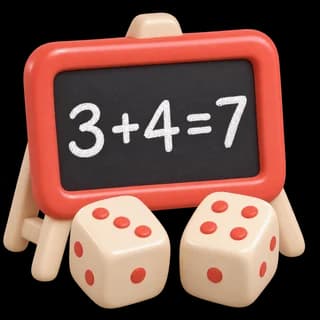
Why Shut the Box teaches addition
A worksheet asks "what is 4 + 5?". Shut the Box asks the question the other way round: here is 9, which numbers make it? On a full 1-9 box the answer is any of 9, 8+1, 7+2, 6+3, 6+2+1, 5+4, 5+3+1, 4+3+2. A child who rolls a 9 has to find at least one of those, check it against the tiles still standing, and choose. That is number bonds practice, and it feels like a game because it is one.
The adding happens twice. First the dice: 4 and 5 is 9. Then the tiles: 6 and 3 is also 9. At the end of the round there is a third sum, adding up the tiles still open to get the score. A single round can easily mean 15 to 20 small calculations, all done willingly.
Kids mode
Our kids mode uses nine tiles and friendlier rules. After each roll a child may shut the tile for the total, or the tile for either die, or both dice as two separate tiles. A 2 and a 5 can shut the 7, the 2, the 5, or the 2 and the 5. The game only lets them tap tiles that can still make a legal move, so they can't get stuck halfway, and there is no score: you either shut the box or you try again. That keeps the pressure off for 5 and 6 year olds while they learn to add two dice.
Classroom rules
Pairs
Put children in pairs with one box, or one printed board and two dice per pair. One rolls, the other checks. Swap after each round. The checker's job is to say the sum out loud ("8 and 1 is 9") before the tiles go down.
Whiteboard version
Write 1 to 9 across the board. Roll big foam dice, or use the dice on this site on a projector. Children suggest which numbers to cross off and explain why. With the whole class watching, you can stop and ask whether 5+4 or 9 was the better choice.
A 10-minute lesson plan
- Two minutes: show one round on the board, saying every sum aloud.
- Five minutes: pairs play two rounds each and write their scores down.
- Two minutes: whoever scored lowest shares one choice they made and why.
- One minute: ask the class which total they rolled most. (Usually 7. See the questions below.)
Multiplication and subtraction versions
For older pupils, multiply the dice instead of adding them and cross the product off a 1-36 board. A 4 and a 6 crosses off 24. The interesting part comes fast: only 18 numbers on that board can ever be made (1, 2, 3, 4, 5, 6, 8, 9, 10, 12, 15, 16, 18, 20, 24, 25, 30, 36). Ask why 7 never comes up, and you are talking about prime numbers. The printable paper board includes a 1-36 grid for this.
For subtraction, take the smaller die from the larger and shut that tile, or tiles that add up to it. A difference of 0 (a double) means roll again. Rounds are long, because differences are small, so use the 1-6 tiles only.
Making it easier or harder
- Easier: use one die and tiles 1 to 6 only, so every roll is a single number to find. Then move to two dice and the kids' rules.
- Standard: the full 1-9 game. Ask the player to say every combination they can see before choosing one.
- Harder: a 1-12 box, which needs three- and four-tile combinations near the end, or digital scoring, where the score is read as a number (1, 2 and 5 left open scores 125) and children practise place value as well.
- Hardest: ask pupils to predict, before rolling, which totals would leave them stuck. That is probability, not just adding.
Questions to ask while playing
- Which total have we rolled most? Why might 7 come up more than 2 or 12? (There are six ways to roll 7 with two dice, and only one way to roll 2.)
- You rolled 10. How many different ways could you shut it? Which one leaves you better off?
- The 1 is still up and you rolled 12. Can you use the 1? (Yes: 1+2+9, or 1+3+8, if those are up.)
- Your score is the tiles left. What is the biggest score possible? (45, if no tile goes down.)
- When would you rather roll one die than two? (When only small tiles are left: two dice can never make a 1.)
- If you could choose any two tiles to keep, which pair would you pick, and why?
Older pupils who enjoy those questions will like the Shut the Box strategy and odds page, which works out the best move for every position.
More dice games with two dice
- Pig. Roll one or two dice as often as you dare and add up the points, but a 1 wipes out your turn. A good game for risk and adding.
- Ship, captain and crew. This one needs five dice. Roll up to three times, needing a 6, 5 and 4 in that order before the other two dice count as cargo.
- Shut the Box variants. Thai style, digital scoring and the party rules on the variations page give the same box a new twist.
Full rules for the standard game are on the Shut the Box rules page.
FAQ
Questions people ask
How to play Shut the Box math game?
Roll two dice, add them, and shut tiles that add up to the total. Each roll asks the player to find number bonds: a 9 can be 9, 8+1, 7+2, 6+3, 5+4 and more. Younger children can play the kids' version, where they may also shut either die on its own.
What age is Shut the Box suitable for?
About 6 and up with help, once a child can add two dice. From 8 or so most children play the full game alone.
What is the game Shut the Box for kids?
A simpler version: shut the tile for the total, or either die, or both dice as two tiles. There is no score; the first player to shut every tile wins.
How does Shut the Box help with math?
Every roll is an addition question with several right answers, so children practise number bonds, mental addition and, when scoring, adding up what is left. Choosing between answers adds simple strategy.
Keep rolling
More ways to play
 Shut the Box GamePlay solo on 9, 10 or 12 tiles, with hints if you want them.
 Play With FriendsA free private room: send the link, everyone plays their own box.
 Daily Shut the BoxSame dice for everyone today. Could you have shut the box?
 Shut the Box RulesHow to play, scoring, the one-die rule and 2 to 4 players.
 Strategy and OddsExact odds and a best-move calculator for any position.
 Variations12 tiles, 4-player boards, Thai style, digital scoring and more.
 PrintablesScore sheet, paper board and a one-page rules PDF.