
Free PDFs
Printable Shut the Box
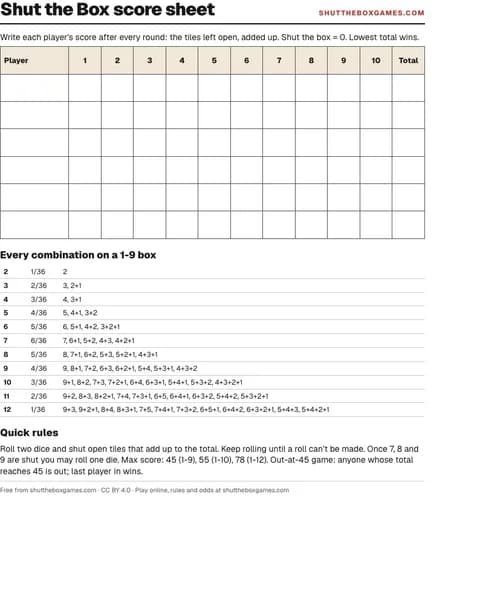
Score sheet
Six players by ten rounds, with a total column, plus every tile combination for each dice total on a 1-9 box.
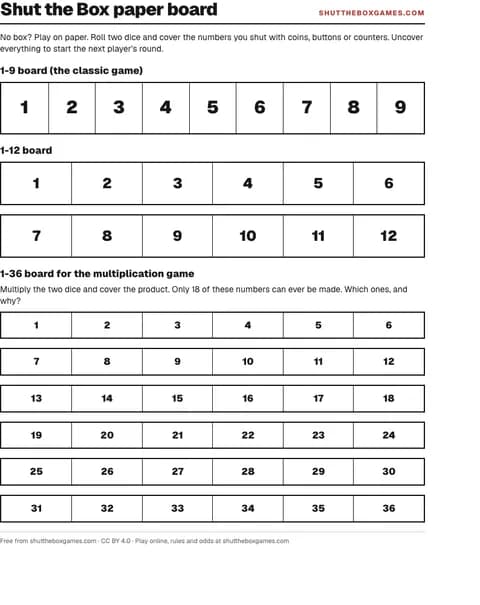
Paper board
A 1-9 strip, a 1-12 strip and a 1-36 grid for the multiplication game. Cover numbers with coins.
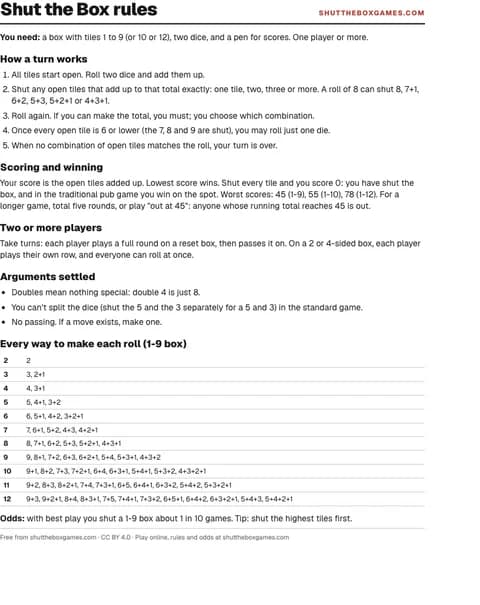
One-page rules
The full rules, scoring, the one-die rule and a table of every combination, on one page.
Score sheet
The score sheet has room for six players and ten rounds, with a total column on the right. Write each player's score after their round: the tiles they left open, added up. A shut box scores 0. Under the grid is a table of every way to make each total from 2 to 12 on a 1-9 box, with how often two dice roll it (7 comes up 6 times in 36, 2 and 12 once). Keep it next to the box and nobody has to argue about whether 9 can go down as 4+3+2. It can.
For a five-round game, total the first five columns. For the out-at-45 format, keep a running total and cross a player off once they reach 45.
Paper board: play without a box
You don't need a wooden box to play. The paper board has the numbers 1 to 9 in big squares, and a 1-12 board below it. Put it on the table, roll two dice, and cover the numbers you shut with coins, buttons or counters. Lift them all off for the next player. It also has a 1-36 grid for the multiplication version on the math game page. Or skip the paper and play online.
One-page rules
The rules sheet covers a turn, the one-die rule, scoring, playing with several people, the arguments about doubles, and a full combination table. It is the short version of the Shut the Box rules page, written to sit in the lid of a new box.
Make your own wooden box
Shut the Box is a popular first woodworking project. A comfortable size for a 1-9 box:
- Tray about 30 cm by 20 cm (12 by 8 inches), with sides about 5 cm (2 inches) tall so dice stay in.
- Nine tiles about 2.5 cm wide and 4 cm tall (1 by 1.5 inches), 6 to 9 mm thick, with a 2 to 3 mm gap between them so they flip freely.
- A rail along the back that holds the tiles, roughly 4 cm deep.
- Felt or cork glued to the floor of the tray to quiet the dice.
Three common ways to let the tiles go down:
- Hinge on a dowel. Drill each tile and run one 6 mm dowel through all of them and the ends of the rail. Tiles flip forward to shut. The drilling has to be straight; a drill press helps.
- Slide in a groove. Cut a groove along the rail and let the tiles slide up and down in it. No hinge to fail, and easy with a router.
- Lift-out pegs. The simplest build: numbered blocks sit in holes and you lift them out to shut them.
Hardwoods like maple, oak or walnut wear well; birch plywood is fine for the tray floor. Burn, paint or stencil the numbers before finishing. Use a food-safe oil or wax if small children will play with it. Make it 10 or 12 tiles long if you want the longer game described on the variations page.
FAQ
Questions people ask
How to play Shut the Box printable?
Print the paper board, grab two dice and some coins. Roll, add the dice, and cover numbers that add up to the total. When you can't make a roll, add up the uncovered numbers: that's your score. Lowest wins.
How to make your own Shut the Box?
Build a shallow tray about 30 by 20 cm with a rail along one side, and fit nine numbered tiles that flip or slide down. Hinge them on a dowel through the rail, or let them slide in a groove. The section above has sizes and materials.
How do you score on Shut the Box?
Add the numbers still open at the end of your turn. Lowest wins, and zero means you shut the box.
Keep rolling
More ways to play
 Shut the Box GamePlay solo on 9, 10 or 12 tiles, with hints if you want them.
 Play With FriendsA free private room: send the link, everyone plays their own box.
 Daily Shut the BoxSame dice for everyone today. Could you have shut the box?
 Shut the Box RulesHow to play, scoring, the one-die rule and 2 to 4 players.
 Strategy and OddsExact odds and a best-move calculator for any position.
 Variations12 tiles, 4-player boards, Thai style, digital scoring and more.
 Math Game for KidsNumber bonds at every roll, a kids mode and classroom rules.