
House rules and other boxes
Shut the Box variations
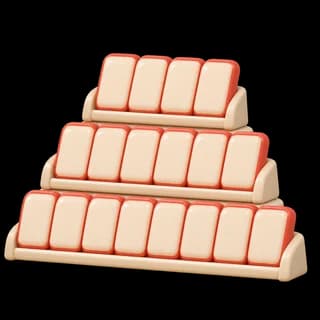
9, 10 and 12 tiles
The pub box has tiles 1 to 9. Many newer sets have 10 or 12. More tiles make a longer round and a much rarer perfect game. With best play and the optional one-die rule, you shut a 9-tile box about 1 in 10 games, a 10-tile box about 1 in 19 and a 12-tile box about 1 in 211. The 12-tile box is called "Full house" in some rule lists. Play this variant: 12 tiles or 10 tiles.
4-player, 6-player and double boards
Multi-player boxes give each player their own row of tiles, on two or four sides of the box. Each player only touches their own row. Some four-sided boards are made for everyone to roll at once, so nobody waits; a round takes as long as the slowest player. Six-player sets work the same way with more sides. Online, our friends rooms play this way with up to 8 players.
Double Shutter is a different game that people confuse with this one. It has two rows of tiles, so each number can be shut twice.
Scoring variants
- Golf scoring is the standard. Add up the open tiles; lowest wins.
- Digital, or "say what you see". Read the open tiles left to right as one number. Open 1, 2 and 5 scores 125, not 8. Leaving three small tiles is now worse than leaving one big one. Play this variant.
- Tiles left (sometimes called missionary scoring) counts how many tiles are open, whatever their numbers. You can pick it in settings.
- Out at 45. Keep a running total. Anyone who reaches 45 points is out, and the last player in wins. Pass and play has this as a format.
- Tournament to 100. The same idea for longer evenings: first to 100 loses, or last under 100 wins.
The one-die rule, three ways
Once the 7, 8 and 9 are shut, can you roll one die? Some say you may, some say you must, some never allow it. The choice changes the odds: on 9 tiles with best play you shut the box 9.8% of the time if one die is optional, 7.4% if it is compulsory, and 7.1% if it is banned. The rules page has the details, and the game lets you pick any of the three.
Thai style or Jackpot
Always roll two dice and shut exactly one tile: one equal to either die, or to their total. A 2 and a 5 lets you shut the 2, the 5 or the 7, but not two tiles. You keep going until no single tile matches. The usual advice is to take the total if it is 7 or more, otherwise the lowest tile you can. That shuts the box 7.9855% of the time. We solved it exactly: best play shuts it 7.9987% of the time, so the advice is very nearly perfect. Play this variant, or see the numbers on the strategy page.
Quick party variants
Wikipedia lists a set of short variants, mostly changes to which tiles start up:
- 2 to go. A standard game, but your first roll must shut the 2 as one of its tiles. Roll a 4 on your first roll and you lose at once.
- 3 to go. The same, with the 3.
- 3 down extreme. Tiles 1 to 3 start shut, so only 4 to 9 are up.
- Lucky 7. Only the 7 is up. The first player to roll a 7 wins.
- Unlucky 7. A standard game, but the moment anyone rolls a 7, the game stops.
- Against all odds. Only the odd tiles start up.
- Even Stevens. Only the even tiles start up.
- The 300. Two boxes and four dice, with the second box standing for tiles 13 to 24. All 24 tiles add up to 300, hence the name. Cards or dominoes can stand in for the second box.
Kids' variant
For young players, let them shut the tile for the total, either die on its own, or both dice as two tiles. A 2 and a 5 can shut the 7, the 2, the 5, or the 2 and the 5. There is no score: the first player to shut every tile wins. It turns every roll into an adding question with several right answers. Play this variant, or read the Shut the Box math game page for classroom ideas.
Shut the Box as a drinking game
Adults sometimes play it in bars with a forfeit for the highest score. Pick forfeits that don't involve alcohol if anyone at the table is driving or under age; telling a story or buying the next round of crisps works fine.
Which variant should you play?
New to the game, or teaching it: the standard 1-9 box with the optional one-die rule. For a longer evening with the same group: five rounds totalled, or out at 45. For a fair contest between good players: play a room with the same dice for everyone, so luck evens out. For young children: the kids' variant. For a change of pace: Thai style, where every roll is a quick one-tile decision and a round rarely lasts more than a minute. If you own a 12-tile box, play it with digital scoring at least once; leaving the 1 and the 12 open scores 112, which teaches you fast why the big tiles matter.
Other names
| Name | Notes |
|---|---|
| Close the Box | A common US name for the same game. |
| Shut the Door | A name you may see on some sets. |
| Canoga | Used in the US, mostly on older sets. The Pacific Game Company sold Canoga sets, including a 12-tile Canoga XII. Not Canoga Park in Los Angeles. |
| Klackers | A common commercial name for sets. |
| Batten Down the Hatches | Found on nautical-themed sets. |
| Trick-track | Listed by Wikipedia as another name. Not to be confused with trictrac, an old French relative of backgammon. |
| Zoltan Box | A name found on some sets. |
| High Rollers | Some American sets, after the US TV game show based on Shut the Box. |
| Jackpot | Usually means Thai style: one tile per roll. |
These are names for the same game, or for sets of it. None of them is connected to this site.
History
Nobody knows where Shut the Box began, and the stories don't agree. One claim puts it in 12th-century Normandy, in northern France, with no source to back it. Another puts it in the Channel Islands (Jersey and Guernsey) in the mid 20th century: Timothy Finn's Pub Games of England (1975) credits it to a man known as "Chalky" Towbridge. A 1967 edition of the Brewing Review called the game native to the Channel Islands and recorded it being played in Manchester pubs in the mid-1960s.
Arthur Taylor's Pub Games (1976) mentions a claim that it dates back to at least Napoleonic times, and reports a revival in British pubs from the 1960s. Canada Dry handed boxes out to many pubs as a publicity novelty some years before Taylor wrote. In pubs it was often played for money. In the US, the NBC game show High Rollers (1974-1976 and 1978-1980) was based on it. Today it is sold mostly as a family game and a maths toy. This site is for fun only: no stakes, no money. These facts come from the sources cited in Wikipedia's article on the game.
Ready to play the standard version? Go back to the Shut the Box game, or read the full rules.
FAQ
Questions people ask
What are some popular variations of Shut the Box?
12-tile boxes, 4-player boards, digital scoring (read the open tiles as one number), out-at-45 tournaments, Thai style where you shut one tile per roll, and a kids' version where you may shut either die.
What is another name for Shut the Box?
Close the Box, Canoga, Batten Down the Hatches and others: Klackers, Zoltan Box, High Rollers, Trick-track and Jackpot.
How to play Shut the Box with 12 numbers?
Exactly like 9: roll two dice and shut tiles that add up to the total. The one-die rule only starts once every tile above 6 is shut, and the worst score is 78.
Is there a Shut the Box game with 12 numbers?
Yes. 1-12 boxes are sold widely and you can play one online here by picking 12 tiles in the settings.
How many numbers can you shut in Shut the Box?
As many as you like in one roll, as long as they add up to the dice total exactly. In standard rules there is no limit.
Where did Shut the Box originate?
Nobody knows for sure. Normandy and the Channel Islands are the usual claims, and a 1967 Brewing Review article called it native to the Channel Islands.
Why is the game called Shut the Box?
Because the goal is to shut every tile. When they are all down, the box is shut.
Keep rolling
More ways to play
 Shut the Box GamePlay solo on 9, 10 or 12 tiles, with hints if you want them.
 Play With FriendsA free private room: send the link, everyone plays their own box.
 Daily Shut the BoxSame dice for everyone today. Could you have shut the box?
 Shut the Box RulesHow to play, scoring, the one-die rule and 2 to 4 players.
 Strategy and OddsExact odds and a best-move calculator for any position.
 Math Game for KidsNumber bonds at every roll, a kids mode and classroom rules.
 PrintablesScore sheet, paper board and a one-page rules PDF.